1. The Golden Rule of Tailoring: Shoulders Dictate Everything
In the world of bespoke menswear, tailors share an adage: 'You can alter the waist, sleeve, and hem in an hour, but if the shoulder is wrong, burn the jacket.' The shoulder seam is the architectural cornerstone upon which the entire garment hangs. Unlike trousers or jacket side seams, recutting a jacket shoulder requires dismantling the collar, sleeves, chest canvas, and armhole lining—a complex surgery that often costs more than off-the-rack suits themselves.
A properly fitted shoulder seam must end precisely at the acromion bone—the outermost point where your horizontal shoulder slope transitions into your vertical upper arm. If the shoulder seam extends past this point, the fabric collapses downward, creating an unsightly dimple or divot beneath the seam. If the shoulder is too narrow, the sleeve pulls upward, restricting arm movement and creating tension creases across your upper back.
Equally crucial is shoulder structure: Neapolitan tailoring utilizes a soft, unpadded 'spalla camicia' (shirt shoulder) that hugs natural curves, ideal for casual blazers. Traditional British tailoring employs structured canvassing and moderate shoulder pads to impart regal authority, while French tailoring favors a roped shoulder head for sharp architectural presence.
Knowing which shoulder construction flatters your skeletal frame transforms your physical presence instantly.
2. Chest Gap, Button Stance, and the Dreaded 'X' Crease
Once the shoulders are secure, attention shifts to the torso. Fasten the top button (on a two-button suit) or middle button (on a three-button suit). Observe the fabric surrounding the button: if deep diagonal tension wrinkles radiate outward from the closure point, forming a distinct 'X', the jacket is excessively tight across the ribs and waist.
A jacket should fasten smoothly, floating approximately 2 to 3 centimeters away from the stomach when standing relaxed, allowing comfortable breathing and seated posture without strain.
Next, inspect the collar behind your neck. A jacket collar should hug your shirt collar flush with zero gap. If there is empty space between the back of your shirt and the jacket collar—known as 'collar gap'—the jacket's posture pitch does not match your forward head posture, causing the garment to tilt backward awkwardly.
Finally, examine lapel roll: the lapels should lie flat against your chest. If they buckle or bow outwards when the jacket is buttoned, the chest canvas is too tight or your pectoral muscle volume requires larger chest darts.
- Fastened button: Smooth closure without tension 'X' wrinkles.
- Collar fit: Zero gap against the back of your dress shirt collar.
- Lapel posture: Lies perfectly flat against the chest without buckling outward.
- Jacket length: Hem covers the curvature of the buttocks and aligns with thumb knuckles.
3. Sleeve Length and the Half-Inch Linen Rule
Few tailoring errors look more amateurish than jacket sleeves that extend down to the knuckles, swallowing the hands in heavy wool. A jacket sleeve is not an overcoat; its express purpose is to frame the wrist and showcase fine dress shirting and cufflinks.
The jacket sleeve should terminate cleanly at the prominent wrist bone (the styloid process of the ulna). When standing with arms relaxed at your sides, precisely 1.0 to 1.5 centimeters (roughly half an inch) of crisp shirt cuff should remain visible below the jacket hem.
This exposed band of shirt linen creates a refined visual boundary that elongates the arm and draws eye movement toward your wristwatch and hands. If wearing a French cuff shirt with cufflinks, ensure the cuff circumference fits comfortably inside the jacket sleeve opening without catching or bunching when you extend your arm.
Adjusting sleeve length from the cuff is a simple tailoring alteration, provided the jacket features non-functional (kissing) buttons rather than cut buttonholes.
4. Trouser Rise and the Break: Full, Half, Quarter, or No Break
The 'break' refers to the crease or fold of fabric formed where the bottom of the trouser leg meets the top of your dress shoe. Choosing the correct break depends on personal stature, shoe silhouette, and formality.
No Break: The trouser hem floats exactly at or slightly above the shoe collar with zero fold. Popularized by modern Italian tailoring, this cut elongates the legs and highlights bespoke loafers or monk straps, but requires slim-tapered cuffs (18-19 cm opening) to avoid looking clipped.
Quarter / Medium Break: The quintessential business standard. The front of the trouser hem rests lightly on the shoe lace area, creating a single subtle ripple while falling straight down the back of the heel. It offers timeless dignity suitable for boardrooms and black-tie galas alike.
Full Break: A traditional British cut where fabric pools in multiple folds over the shoe. While acceptable on heavy winter tweeds or wide-leg vintage trousers, a full break on modern slim suits makes the wearer appear shorter and untidy.
Trouser rise is equally paramount: formal suiting demands a mid-to-high rise that sits comfortably near the natural waist, eliminating unsightly shirt billow above the belt.
5. Testing Suits and Tuxedos Virtually with VirtuStyle AI
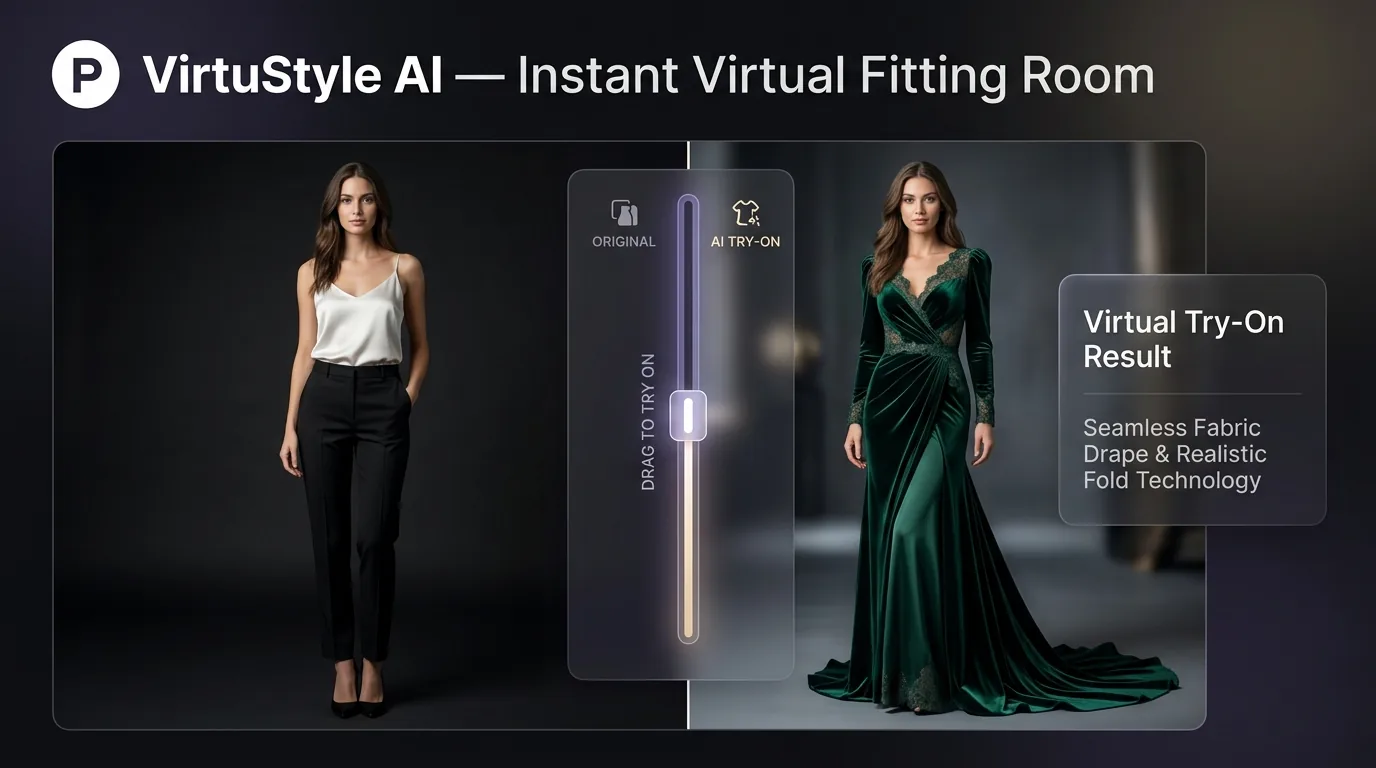
Use VirtuStyle AI to explore single- and double-breasted suit styles on your own photo. Upload a person photo and a clear garment image, then compare the generated appearance with the original product.
Treat the result as an illustration of a possible look. The model may change construction details, patterns or proportions; it does not calculate verified body dimensions or simulate material physics.
Check the retailer’s measurements and fabric description separately. A generated image cannot establish comfort, support, warmth, stretch or how the item behaves while moving.
If a detail is unclear, try a clearer source image and compare again. Keep the original product page for checking measurements and return conditions before ordering.
Frequently asked questions
What is the difference between peak lapels and notch lapels?→
Notch lapels feature a sideways V-indentation and are standard for everyday business suits. Peak lapels point upwards towards the shoulders, creating an optical broadening of the chest; they are traditional on double-breasted suits and black-tie tuxedos.
Should a tuxedo jacket always have satin lapels?→
Yes. The defining distinction of a black-tie tuxedo (dinner jacket) is satin or grosgrain silk facing on the lapels, buttons, and matching stripe down the trouser leg seam.
How do I know if my suit trousers are too tight?→
If the trouser pockets flare open like elephant ears when you stand normally, the trousers are too tight across the hips and seat. Pockets should lie completely flat against the thigh.
Can I test different suit colors on my photo to see what matches my skin tone?→
You can explore single- and double-breasted suit styles as a visual preview. Generated details and colours can differ from the actual garment. This tool cannot verify measurements, tightness, support or comfort; check those with the seller.
What to remember
The Anatomy of a Perfect Suit Fit. Use the practical checks above to shortlist options, then verify size, materials and comfort with the seller. A virtual preview can help you compare appearance, but cannot guarantee fit or replace a physical fitting.